Free VPNs promise a lot: privacy, access to blocked content, and secure browsing—at no cost. On paper, that’s hard to argue with. But after using both free services and NordVPN side by side, the differences show up quickly—and not just in speed.
The real question isn’t whether free VPNs work.
It’s how much you’re willing to compromise.
Free VPNs: Convenient, but Limited by Design
Free VPNs operate under tight constraints. Servers are limited, bandwidth is often shared across large numbers of users, and features are stripped down to reduce costs.
In practice, that means:
- Slower speeds during peak times
- Frequent disconnections
- Limited server locations
Some services—like those offered by Proton AG—focus more on privacy and avoid aggressive monetization. But even these come with restrictions on speed or server access.
You’re not paying with money.
But you are paying with performance.
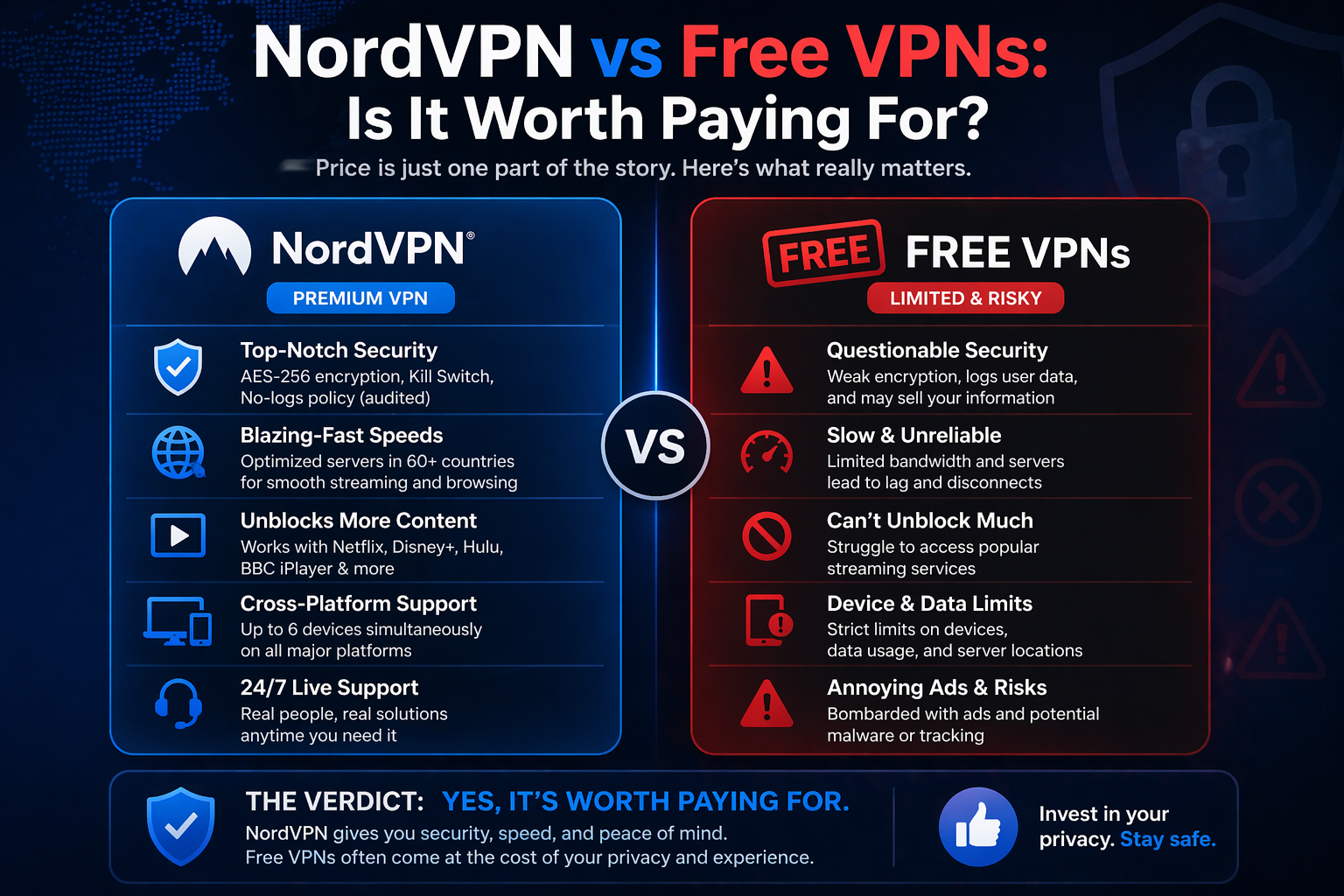
NordVPN: What You’re Paying For
NordVPN removes most of those limitations. It offers a large server network, consistent speeds, and features designed for everyday use—like automatic connection, kill switch protection, and integrated threat blocking.
The technical details matter less than the outcome.
You connect once, and things just work.
That reliability is what you’re paying for—not just encryption, which free VPNs also offer, but consistency.
Speed and Stability: The First Real Difference
Speed is where the gap becomes obvious.
Free VPNs often struggle under load. Too many users on too few servers leads to congestion, which shows up as buffering, lag, or dropped connections.
NordVPN, using its NordLynx protocol, maintains stable performance even during peak hours.
It’s not just faster.
It’s more predictable.
Privacy: Not All “Free” Is Equal
Privacy is often the main reason people use a VPN—but it’s also where free services vary the most.
Some free VPNs log user activity or rely on ads to generate revenue. Others are more transparent, but still limited by infrastructure constraints.
NordVPN operates on a subscription model, which removes the need to monetize user data. Its no-logs policy has been independently audited, adding a layer of trust that free services don’t always provide.
That distinction matters.
Especially if privacy is your primary concern.
Streaming and Real-World Use
If you’re using a VPN to access streaming content, free services are inconsistent at best. Many are blocked outright by platforms like Netflix, or require frequent server switching.
NordVPN performs more reliably here, with servers optimized for streaming and faster adaptation when blocks occur.
It’s not flawless.
But it’s far less frustrating.
Pricing: The Trade-Off
NordVPN isn’t the cheapest option, but it’s also not the most expensive. Long-term plans make it more accessible, though monthly pricing remains relatively high.
Free VPNs win on cost.
But only if you’re comfortable with their limitations.
The decision comes down to whether you value consistency enough to pay for it.
Pros and Cons
NordVPN Pros
- Fast and stable performance
- Strong privacy protections with audited no-logs policy
- Reliable streaming access
- Wide server network
NordVPN Cons
- Higher cost compared to free options
- Some features may be unnecessary for casual users
Free VPN Pros
- No upfront cost
- Easy to try without commitment
Free VPN Cons
- Slower speeds and limited servers
- Inconsistent performance
- Potential privacy concerns
- Poor streaming reliability
Who Should Pay (and Who Might Not Need To)
If you use a VPN occasionally—checking a website or browsing casually—a free VPN may be enough.
But for regular use, especially streaming, remote work, or privacy-focused browsing, the limitations become noticeable quickly. That’s where NordVPN offers a more stable experience.
It’s less about features.
And more about removing friction.
The Bigger Picture
The VPN market has matured. Free options are better than they used to be, but the core trade-off remains: free services optimize for accessibility, while paid services optimize for performance and reliability.
NordVPN sits firmly in the latter category.
The Bottom Line
So, is NordVPN worth paying for over a free VPN?
In most cases, yes.
Free VPNs can work in a pinch, but they come with compromises that affect both performance and trust. NordVPN doesn’t eliminate every limitation, but it removes the ones that matter most in daily use.
Final verdict:
If you want a VPN that works consistently and doesn’t require constant adjustments, paying for NordVPN is a practical decision. Free VPNs are convenient—but they rarely deliver the same level of reliability or confidence.

