Best Hosting Deal Right Now
Hostinger ⭐ 4.9/5
- ⚡ Ultra fast performance
- 💰 From $2.99/month
- 🛡 Free SSL + domain
Cheap web hosting is easy to find and even easier to justify—especially if you’re launching a personal blog, small business site, or side project. Plans often start at just a few dollars a month, promising “unlimited” storage, free domains, and one-click installs.
On paper, it looks like a no-brainer.
In practice, the trade-offs are harder to ignore.
What “Cheap Hosting” Really Means
Most budget hosting plans are based on shared infrastructure. That means your website lives on the same server as dozens—or sometimes hundreds—of other sites.
When traffic is low, this works fine.
But when other sites on the same server get busy, your performance can drop. Slower load times, occasional downtime, and inconsistent speeds are common side effects.
You’re not just paying less.
You’re sharing more.
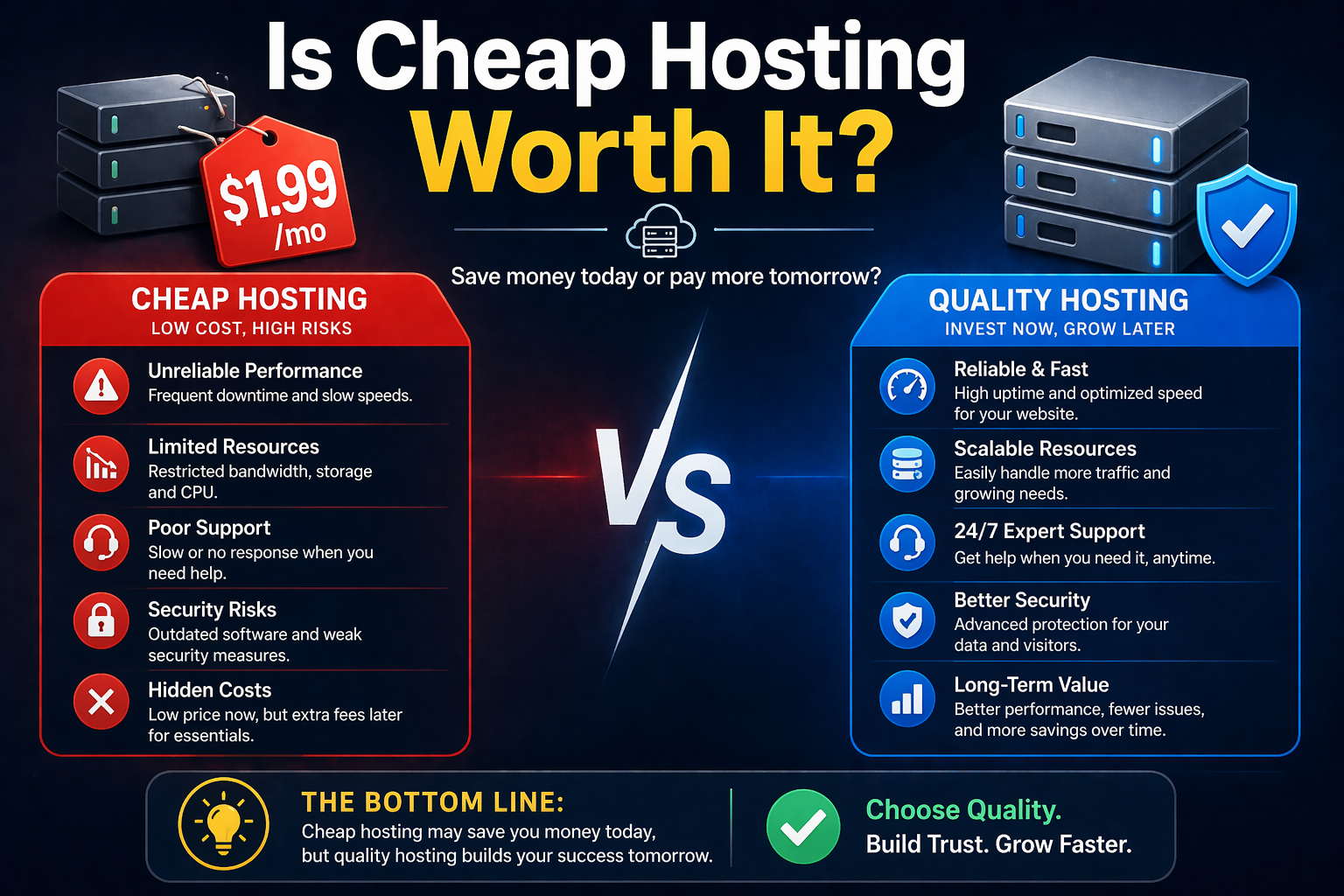
Performance: Good Enough—Until It Isn’t
For small, low-traffic websites, cheap hosting usually performs adequately. A personal blog or portfolio site can run smoothly without noticeable issues.
But as traffic grows, limitations become more obvious.
Pages may load slower, especially during peak hours. And if your site depends on speed—like e-commerce or SEO-driven content—those delays can have real consequences.
Compared to higher-tier hosting, the difference isn’t always dramatic at first.
But it becomes more noticeable over time.
Reliability and Uptime
Budget hosting providers often advertise high uptime guarantees, but real-world performance can vary.
Shared servers are more vulnerable to spikes in usage, which can lead to temporary outages or slower response times. Support response times may also be slower compared to premium services.
It’s not that cheap hosting is unreliable.
It’s that it’s less consistent.
Features: Plenty on Paper, Limited in Practice
Cheap hosting plans often include long lists of features—free SSL certificates, email accounts, website builders.
Most of these work as advertised.
But there are limits behind the scenes: storage caps, CPU usage restrictions, and bandwidth throttling. These aren’t always obvious until your site grows or usage increases.
The features are real.
The limits just aren’t always visible upfront.
Security: Basic, but Not Comprehensive
Security on cheap hosting is usually sufficient for basic needs. SSL certificates and basic protections are standard.
However, advanced features—like proactive malware scanning, automated backups, or dedicated firewalls—are often limited or require upgrades.
For low-risk sites, this may be enough.
For business-critical projects, it may not be.
Cheap Hosting vs Premium Hosting
The main difference comes down to resources and control.
- Cheap hosting: Shared resources, lower cost, limited performance consistency
- Premium hosting (VPS or managed hosting): Dedicated resources, better performance, higher cost
Premium hosting doesn’t just offer faster speeds—it provides more predictable performance, which matters as your site grows.
It’s less about raw power.
More about stability.
Pros and Cons
Pros
- Very affordable entry point
- Easy setup with beginner-friendly tools
- Sufficient for small or low-traffic sites
Cons
- Shared resources can affect performance
- Less consistent uptime and speed
- Hidden limitations on usage
- Limited support and advanced features
Who Should Use Cheap Hosting
Cheap hosting makes sense if you’re starting out—testing an idea, building a personal site, or learning how websites work.
It’s low-risk and accessible.
And for many users, that’s enough.
Who Should Avoid It
If your website is tied to revenue, traffic growth, or brand reputation, cheap hosting can become a bottleneck.
Slow load times and downtime don’t just affect performance.
They affect user trust.
The Bigger Picture
Cheap hosting lowers the barrier to entry for building websites, which is a good thing. It allows more people to experiment, create, and publish online without significant upfront cost.
But it’s not designed for long-term scaling.
It’s designed for getting started.
The Bottom Line
Cheap hosting is worth it—within limits.
It works well for small projects and early-stage websites, but its constraints become more noticeable as your needs grow.
Final verdict:
Cheap hosting is a practical starting point, not a long-term solution. Use it to launch and learn—but be prepared to upgrade when performance and reliability start to matter.
Best Hosting Deal Right Now
Hostinger ⭐ 4.9/5
- ⚡ Ultra fast performance
- 💰 From $2.99/month
- 🛡 Free SSL + domain

