For years, “cloud hosting” has been marketed as the future—and “shared hosting” as the cheap starting point. That narrative isn’t wrong, but it’s also not the full story.
Because in practice, choosing between the two isn’t about technology. It’s about how your website behaves when real people start visiting it.
And that’s where the differences become obvious.
The Core Difference (Without the Jargon)
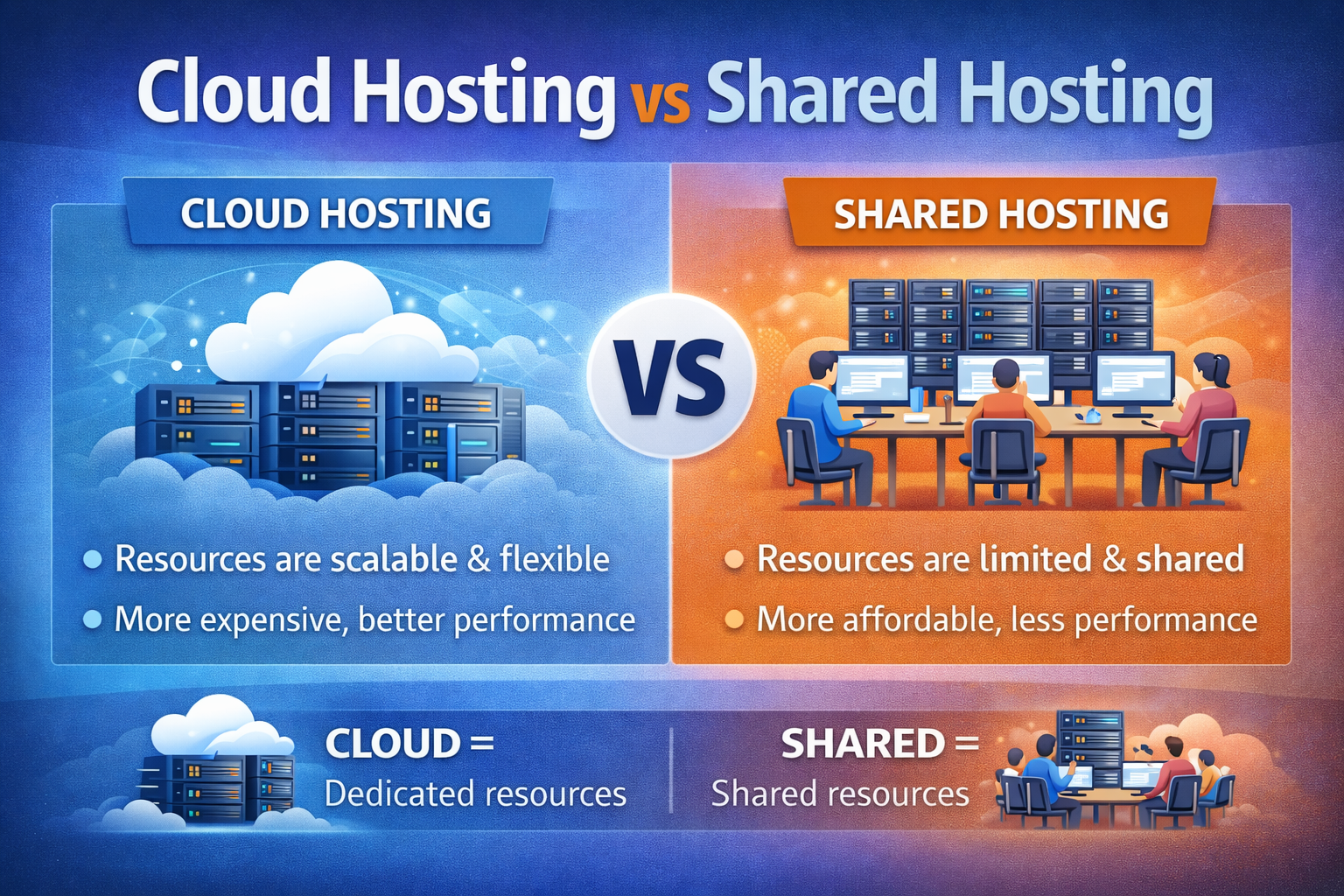
Shared hosting means your website lives on a single server, alongside dozens—or even hundreds—of other sites. Everyone shares the same resources: CPU, memory, bandwidth.
Cloud hosting spreads your site across multiple servers. If one server struggles, another picks up the load.
That’s the technical explanation.
The practical one?
Shared hosting is like living in an apartment building. Cloud hosting is more like having access to multiple buildings at once.
⚠️ Affiliate disclosure: We may earn a commission at no extra cost to you.
🔥 Editor's Picks
Best Hosting Deal Right Now
🔥 BEST HOSTING
Hostinger ⭐ 4.9/5
- ⚡ Ultra fast performance
- 💰 From $2.99/month
- 🛡 Free SSL + domain
🚀 Get 80% OFF Hostinger
Shared Hosting: Cheap, Simple, and Surprisingly Limiting
Best Hosting Deal Right Now
Hostinger ⭐ 4.9/5
- ⚡ Ultra fast performance
- 💰 From $2.99/month
- 🛡 Free SSL + domain
Shared hosting still dominates the entry-level market for a reason: it’s easy and affordable.
You sign up, install WordPress in one click, and your site is live in minutes. For small blogs or personal sites, it often works just fine.
At first.
But over time, the cracks show.
Because resources are shared, your performance depends on what other websites on the same server are doing. If one site gets a traffic spike, yours can slow down—even if nothing changed on your end.
That unpredictability is the biggest issue.
Pros
- Very affordable
- Beginner-friendly setup
- Enough for low-traffic sites
Cons
- Performance can be inconsistent
- Limited scalability
- Slower load times under pressure
It works—until it doesn’t.
Cloud Hosting: Flexible, Fast, and More Predictable
Cloud hosting solves the biggest weakness of shared hosting: resource limits.
Instead of relying on one server, your site can scale across multiple machines. If traffic increases, your resources increase with it—automatically in many cases.
In real-world use, this means:
- Faster load times during traffic spikes
- More stable performance overall
- Less risk of downtime
It’s not just about speed. It’s about consistency.
But there’s a trade-off.
Pros
- Scales with your traffic
- More reliable performance
- Better uptime and redundancy
Cons
- More expensive
- Slightly more complex setup
- Can feel like overkill for small sites
You’re paying for flexibility—even if you don’t always need it.
Real-World Performance: Where the Gap Shows
On a quiet day, shared hosting and cloud hosting can feel similar. A small blog with low traffic might load just as fast on both.
But add real traffic—say, a post goes viral or gets picked up by search engines—and the difference becomes clear.
Shared hosting:
- Slows down
- May temporarily limit your site
- Can even crash under heavy load
Cloud hosting:
- Absorbs the spike
- Keeps performance stable
- Recovers quickly
This is where cloud hosting earns its reputation.
Cost vs Value: The Trade-Off Most People Misjudge
Shared hosting wins on price. No question.
But it’s also where hidden costs appear:
- Upgrades as traffic grows
- Add-ons for basic features
- Time spent dealing with slow performance
Cloud hosting costs more upfront—but often saves time and frustration later.
It’s less about saving money, and more about avoiding bottlenecks.
Who Should Choose What?
If you’re launching a personal blog, portfolio, or small site:
- Shared hosting is enough
- Keep it simple and low-cost
If you expect growth, traffic spikes, or want a smoother experience:
- Cloud hosting is the better choice
If your site is part of a business:
- Shared hosting quickly becomes a limitation
This isn’t about scale—it’s about expectations.
The Bigger Picture: It’s About Stability, Not Just Speed
Speed gets all the attention. But stability is what actually matters.
A slightly slower site that’s consistent is better than a fast site that breaks under pressure.
That’s the real advantage of cloud hosting.
Final Verdict: The Smarter Choice Depends on Your Intent
Cloud hosting isn’t “better” in every situation. And shared hosting isn’t obsolete.
But they serve very different purposes.
Shared hosting is a starting point.
Cloud hosting is a growth platform.
If you’re experimenting, learning, or building something small, shared hosting is fine.
But if you’re building something you expect people to actually use—and rely on—cloud hosting is the more future-proof choice.
In 2026, the real question isn’t which is better. It’s how long you plan to stay small.
Best Hosting Deal Right Now
Hostinger ⭐ 4.9/5
- ⚡ Ultra fast performance
- 💰 From $2.99/month
- 🛡 Free SSL + domain

