Best Hosting Deal Right Now
Hostinger ⭐ 4.9/5
- ⚡ Ultra fast performance
- 💰 From $2.99/month
- 🛡 Free SSL + domain
There’s a growing sense that data centers are no longer just infrastructure—they’re becoming something closer to industrial production lines for intelligence. With the latest announcement from Super Micro Computer, that idea feels more real than ever. By introducing a full portfolio built around the NVIDIA Vera Rubin platform, the company isn’t just launching new hardware—it’s aligning itself with what could be the next phase of computing: AI factories at scale.
At the center of this shift is NVIDIA’s Vera Rubin ecosystem, combining GPUs, CPUs, networking, and memory into tightly integrated systems. Supermicro’s approach builds on this foundation but adds something equally important: deployability. Through its Data Center Building Block Solutions (DCBBS), the company is essentially packaging complex AI infrastructure into modular, ready-to-deploy units. That may sound like a technical detail, but it solves one of the biggest bottlenecks in AI today—not performance, but time-to-deployment.
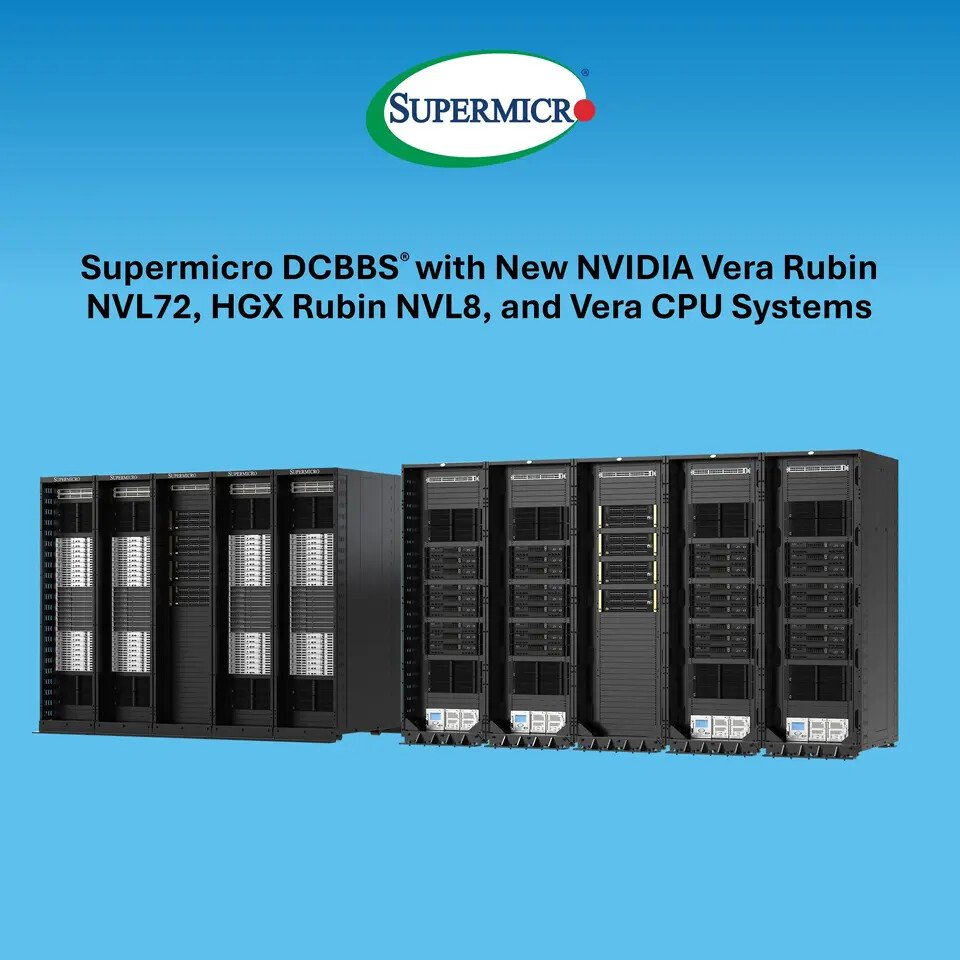
What stands out immediately is the scale. The Vera Rubin NVL72 SuperCluster is designed as a rack-scale accelerator capable of delivering up to 3.6 exaflops of inference performance, with massive memory bandwidth and efficiency gains compared to previous generations like Blackwell. But raw numbers only tell part of the story. The real innovation lies in how everything is connected: GPUs, CPUs, DPUs, and networking all working as a unified system rather than separate components.
Compared to traditional data center setups—where companies piece together servers, cooling, and networking from multiple vendors—Supermicro’s model is far more integrated. It competes not just with other hardware vendors, but with entire system ecosystems from hyperscalers and companies like Dell or HPE. The difference is in philosophy:
-
Traditional infrastructure: flexible, but complex and slower to deploy
-
Supermicro DCBBS: modular, pre-validated, faster to scale with lower integration risk
This becomes especially important as AI workloads evolve. Technologies like long-context AI, agentic reasoning, and Mixture-of-Experts models demand not just compute power, but consistent data flow, low latency, and efficient cooling. And cooling, in particular, is becoming a defining factor. With fully liquid-cooled systems now standard for Vera Rubin platforms, Supermicro is betting heavily on advanced thermal design as a competitive edge.
Another interesting angle is flexibility. While NVIDIA is pushing its own CPUs like Vera, Supermicro’s HGX Rubin NVL8 systems still support x86 options from Intel and AMD. This hybrid approach could be a major advantage, allowing customers to adopt new AI architectures without abandoning existing software ecosystems.
In terms of cost, these systems are clearly aimed at the high end of the market. The upfront investment for liquid-cooled, rack-scale AI infrastructure is enormous. However, Supermicro’s argument—similar to NVIDIA’s—is centered on efficiency and total cost of ownership. Higher throughput per watt, reduced deployment time, and optimized system integration could offset initial expenses over time, especially for organizations running large-scale inference workloads.
It’s also worth noting how this compares to current-generation systems. Supermicro’s existing Blackwell-based platforms are already in production, providing a bridge between today’s AI infrastructure and the next generation. This dual strategy—supporting both present and future—helps reduce risk for customers navigating a rapidly evolving landscape.
Personal perspective:
This announcement reinforces a broader trend: AI infrastructure is no longer about individual components, but about complete, vertically integrated systems. Supermicro isn’t just competing on hardware specs—it’s competing on how quickly and efficiently organizations can turn AI into a working, scalable operation. And in a world where speed to deployment can define competitive advantage, that might matter more than raw performance alone.
Best Hosting Deal Right Now
Hostinger ⭐ 4.9/5
- ⚡ Ultra fast performance
- 💰 From $2.99/month
- 🛡 Free SSL + domain

